

What Actually Moves the Needle in Local SEO for Plumbers
 Miguel Umbac· SEO, Web Development & Automation
If you're a plumber, here's what actually moves the needle for local SEO: your Google Business Profile category, how often new reviews come in, whether each service has its own page, and whether your site survives someone tapping "call" from a phone during an actual emergency. Everything else is secondary.
I already covered local SEO fundamentals: the Map Pack, GBP, citations, and reviews as four separate parts. This post follows those four parts through, in order, for one trade: plumbing.
- Your primary Google Business Profile category decides more of your Map Pack eligibility than almost anything else on the listing.
- Google retired the GBP Q&A section for Ask Maps, an AI feature that answers customer questions from your profile, reviews, and website, so there's no longer a field to write a direct answer in.
- Emergency search terms like "burst pipe" or "no water emergency plumber" convert differently than research terms like "water heater replacement cost." Each intent needs its own page, not one blended services page.
- Service area pages only help if they carry real local detail. Swapping in a city name isn't enough, and Google can tell.
- Reviews, citations, and schema markup all do the same job in Google's eyes: confirming the business is real and consistent everywhere it's listed.
- None of this compounds if the site is too slow to survive a panic tap-to-call.
Your Google Business Profile Category Decides More Than You Think
Google matches your profile against a pool of competitors based on your primary category first, and Google's own guidance treats that field as the strongest single signal on the whole listing.
Choosing a Primary Category
Most plumbing businesses should stick with "Plumber." If a specific service genuinely drives most of the revenue, water heater work being the common case, a narrower category like "Water Heater Repair Service" can outperform the generic one, but only if the business can actually dispatch a truck for it the same day.
Secondary Categories
These work the same way in miniature. Adding "Drainage Service" or "Sewer Repair Service" expands what the profile can match. Adding "Electrician" or "General Contractor" because it might catch more search volume does the opposite: it dilutes the match instead of expanding it, so Google has a harder time deciding what the business actually is.
Photos That Actually Help
Real photos, not stock. A branded van, a technician mid-repair, an actual before-and-after of a pipe job. Stock photography tells a customer nothing about who's about to show up at their house.
The Q&A Section Is Gone
Google retired the old Q&A section and replaced it with Ask Maps, an AI feature that answers customer questions in real time by pulling from the GBP listing, reviews, and the business's own website. There's no field left to write a pre-set answer in anymore. The practical response is the same one that helps everywhere else on this page: keep the profile, reviews, and website detailed and accurate, since that's exactly what Ask Maps draws from when it answers a question about the business.
Once the profile is pulling from the right pool of competitors, the next question is what those competitors are actually being searched for.
Match Your Content to How Customers Actually Search
A pipe bursts at 11 p.m. on a Friday. That search and a Tuesday-afternoon search for "water heater replacement cost" come from two different mental states, and most plumbing sites write one page trying to serve both.
| Intent | Example searches | What they actually want | What the page should do |
|---|---|---|---|
| Emergency | burst pipe, no water emergency plumber, 24 hour plumber, clogged drain repair | Someone there now | Tap-to-call above the fold, minimal reading, fast load |
| Informational | water heater replacement cost, how to unclog a garbage disposal | To understand the problem before deciding | A clear answer, then a link into the right service page |

That split is also why a single "Plumbing Services" page competes against itself. Water heater repair, drain cleaning, sewer line repair, and leak detection each need their own page, built around what a customer wants to know before they call: the warning signs, what a typical visit involves, and whether same-day service is realistic for that specific problem.
None of that content matters, though, if the page it lives on doesn't actually describe the place it's supposed to rank for.
Service Area Pages That Don't Read Like a Template
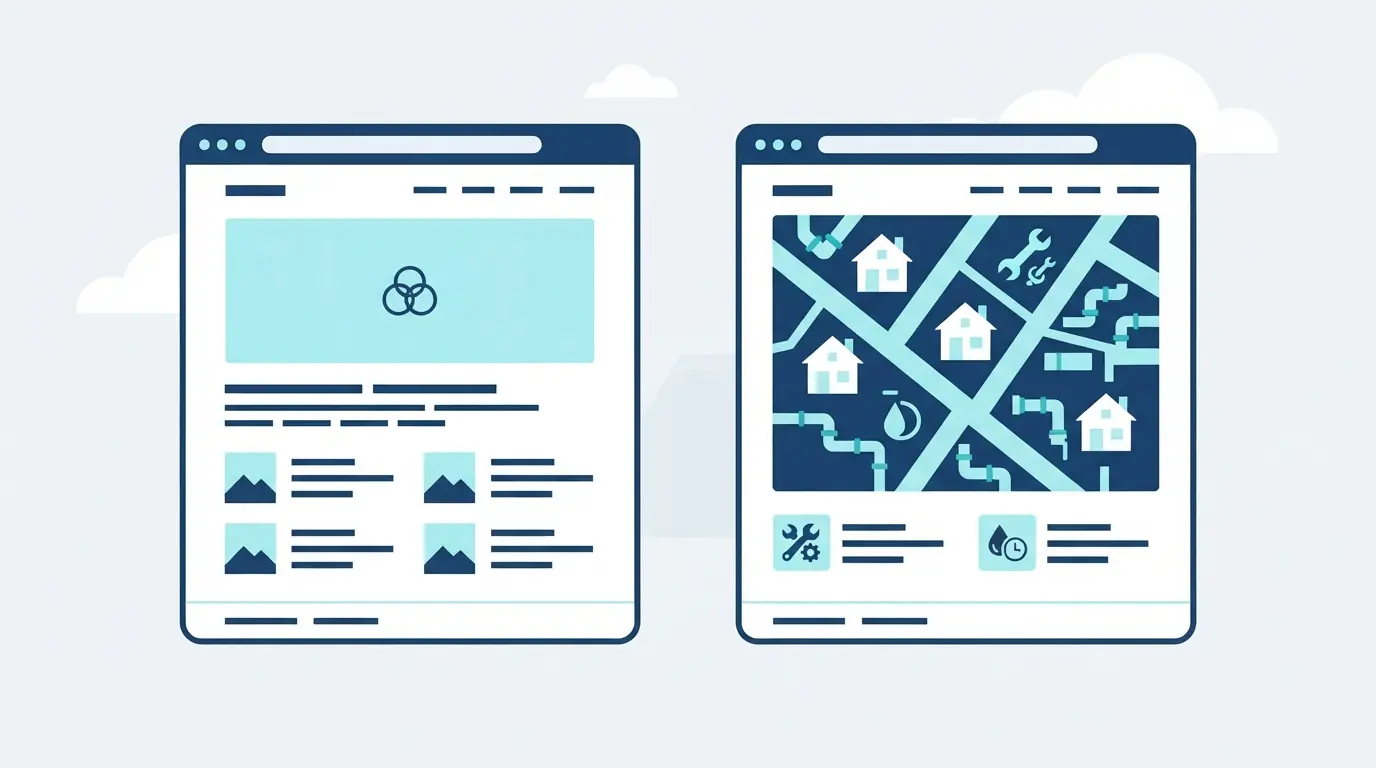
Google's own ranking guidance leans heavily on proximity to a physical address, so one Google Business Profile can't realistically win the Map Pack thirty miles from where it's registered. The usual fix, a stack of near-identical city pages with only the town name swapped, doesn't work. Google can tell.
A version that does work splits the job in two: let the Google Business Profile carry the immediate service radius around the real address, and build dedicated pages only for the surrounding towns the business genuinely serves. Each of those pages needs something true and local to say, not a template with a new name dropped in:
- The pipe corrosion that comes with that area's water hardness
- Older neighborhoods with aging cast iron
- An embedded map of the real service radius
- Reviews from customers in that specific area, if there are any
A complete profile and honest area pages still don't mean much if Google, or a customer, has no way to confirm the business behind them is legitimate. That's what citations, reviews, and structured data are for.
Building Trust Google Can Verify
NAP and Citation Consistency
NAP, name, address, and phone number, is the detail Google cross-checks across every place a business appears online. Small mismatches, "St." on one directory and "Street" on another, weaken that trust signal even when they look harmless to a person reading them.
| Tier | Sources |
|---|---|
| Primary | Google Business Profile, Bing Places, Apple Maps |
| Trade directories | Angi, Thumbtack, HomeAdvisor |
| Hyperlocal | Chamber of commerce, state plumbing licensing portal |
Fixing the top two tiers consistently does more than chasing volume across dozens of low-relevance directories further down the list.
Review Volume and Timing
According to BrightLocal's 2024 survey, 59% of consumers say they need to see somewhere between 20 and 99 reviews before they'll trust a business's star rating at all. Sitting in the single digits is a real barrier, independent of how good that rating looks.
Recency matters alongside volume. That same survey found 27% of consumers now expect to see reviews from within the past two weeks specifically, up from 22% two years earlier. A pile of reviews from three years ago doesn't cover that expectation the way a steady weekly trickle does.
Getting past that threshold comes down to a simple routine:
- Send a text or email within a couple hours of the job finishing, while the customer's still glad the water's back on
- Have the technician mention it out loud before leaving
- Never trade a discount for a review. It's against most platforms' policies and can get a profile suspended
Schema Markup
Schema markup is the same idea in code. A Plumber type (a subtype of LocalBusiness) with the same name, address, phone, service area, and hours as the GBP listing gives Google, and increasingly AI answer engines, a structured version of the exact consistency check above. It won't rank a page by itself, but it removes any doubt about which business the page belongs to.
A business that clears every check above can still lose the job in the five minutes after the phone rings.
None of This Matters If the Call Doesn't Get Answered
A plumber can rank first in the Map Pack and still lose the customer. The usual failure points:
- Slow mobile load.Google's own Core Web Vitals guidance puts good load time at 2.5 seconds or less. A mobile site that misses that mark during an actual burst-pipe search loses the click before the page even finishes loading.
- No text-back. A missed call with no automatic follow-up hands the job straight to the next result.
- A lead that sits. Twenty minutes in an unanswered inbox is enough time for someone with a flooded bathroom to call the next plumber down the list.
Local SEO gets the phone to ring. What happens next is a separate system, and it's usually the one that decides who actually gets hired. I build both sides of that together for contractor clients, which is the systems and automation half of this (see Systems & Automation).
That gap between ranking and answering is the pattern I run into most often building these systems for trade contractors.
What I've Seen Building Local SEO Systems for Contractor Clients
The most common self-inflicted wound isn't a missing citation or a thin page. It's category dilution: an owner adds "General Contractor" or "Handyman" as a secondary GBP category hoping to catch more search volume, and instead waters down how cleanly Google can match the profile to "plumber near me" style searches. Pulling those unrelated categories back out is often a bigger single-day fix than anything else on this page.
Frequently Asked Questions
How long does local SEO take for a plumber to see results?
It varies by market and how strong the existing profile and reviews already are. Most plumbers see early movement within the first few months, with more competitive positions building over a longer stretch as reviews and citations accumulate. There's no fixed timeline any honest source can promise.
Should a plumber run Google Local Services Ads while doing SEO?
Local Services Ads sit above both the Map Pack and organic results, and they pull directly from the same Google Business Profile data: categories, reviews, service areas. Strengthening the profile for SEO tends to help the ad listing too, so the two aren't really competing strategies.
Does a plumber need a page for every city they serve?
No. A page only helps if it's built for a place the business genuinely serves and has real local detail to say about it. A stack of near-identical pages with the city name swapped is more likely to hurt a site's overall quality than help it rank anywhere.
What's the fastest way to get more Google reviews as a plumber?
A text or email sent within a couple hours of the job finishing, paired with a technician who mentions it in person before leaving. Never offer a discount in exchange for a review.
See Exactly What's Costing You Rankings
A personal 5-minute video audit from Miguel, delivered in 24 hours, no sales call.
Comments
Join the conversation. All comments are moderated prior to publication.
Leave a Reply
Your email address will not be published. Required fields are marked *
Related Playbooks
More articles matching this topic and category.

Local SEO for Electricians
What Local SEO Actually Means for a Home Service Business (2026)