

What Is Speed to Lead? Why 5 Minutes Beats 30
 Miguel Umbac· SEO, Web Development & Automation
Speed to lead is the time between a customer reaching out and your business sending a real reply. For a contractor, the clock starts when a form is sent, a call goes to voicemail, or a text comes in.
Faster is better, and the research draws the line at about five minutes. After that, your odds of even reaching the customer drop fast. The hard part is that most contractors are on a job when the lead arrives. So a trade business needs a system that answers first, even when you can't.

Key Takeaways
- Speed to lead is the time from a customer's first contact to your first useful reply.
- In a 2007 MIT study, leads called within 5 minutes were 100 times more likely to be reached than leads called at 30 minutes.
- A 2011 Harvard Business Review audit of 2,241 U.S. companies found an average response time of 42 hours.
- Most contractors miss the window because they're working, not because they don't care.
- A speed to lead system alerts you and replies to the customer within seconds, so the first minutes are covered.
What Counts as Your Lead Response Time?
Your lead response time is the gap between a customer contacting you and that customer getting a useful reply. It starts the second a form is sent, a call is missed, or a text arrives. It doesn't start when the email finally reaches you, because the customer has been waiting since they hit send.
A plain "we got your message" auto-reply earns partial credit. It shows someone is there, but it doesn't move the job forward. A reply that asks one real question, or offers a time to talk, is what truly stops the clock. So how much do those minutes actually matter?
Speed to Lead Statistics That Hold Up
Most speed to lead statistics online trace back to two studies, both led by researcher James Oldroyd. Many posts repeat the numbers without naming either one. Here is what each study found and what it actually measured.
| Finding | Source | What was measured |
|---|---|---|
| Leads called within 5 minutes were 100 times more likely to be reached than leads called at 30 minutes | MIT Lead Response Management Study (2007) | Call data from 6 companies, 15,000+ leads, and 100,000+ call attempts |
| Leads called within 5 minutes were 21 times more likely to qualify than leads called at 30 minutes | Same MIT study | Whether the call became a real sales conversation |
| Waiting 10 minutes instead of 5 cut the odds of reaching the lead by 5 times | Same MIT study | Contact rate |
| Across the first hour, contact odds fell more than 10 times and qualifying odds more than 6 times | Same MIT study | Contact and qualifying rates |
| Firms that replied within an hour were nearly 7 times more likely to qualify the lead than firms that waited one hour longer, and over 60 times more likely than firms that waited a day | Harvard Business Review (2011) | 1.25 million leads at 42 U.S. companies |
| The average response time was 42 hours, and 23% of companies never replied at all | Same HBR article | Test leads sent to 2,241 U.S. companies |
Both studies share one honest limit. They tracked contact and qualified conversations, not closed jobs. HBR defined "qualified" as a real conversation with the person who makes the decision. The fair takeaway is simple: a fast reply gets you into far more conversations, and you can't win a job you never talk about.
You'll also see claims like "78% of customers buy from the first company to respond" or "391% more conversions in the first minute." The first has no study behind it that I could find. The second traces to a lead software vendor's own customer data, not published research. I left both out. The two real studies are enough to show what's at stake for a trade business.

Why 5 Minutes Beats 30 for a Trade Business
Five minutes beats 30 because a homeowner with a problem keeps searching until someone answers. Picture a burst pipe for a plumber, or a dead AC unit in July for an HVAC company. The homeowner sends your form, then calls the next company on the map.
The first company to reply often wins the job by default. The customer wants the problem gone, and a real answer feels like progress. By minute 30, they may have already booked someone else.
Planned jobs follow the same pattern, just slower. A homeowner asking three roofers for quotes still notices who answered first. Your reply speed is their first proof of how you'll run the job. Yet most contractors miss the window, and usually for the same few reasons.
Why Contractors Miss the 5-Minute Window
Contractors miss the five-minute window because leads arrive while they're working. You can't answer a form from a ladder. These are the gaps I see most often:
- You're on a job. Your phone is in the truck, or your hands are full.
- The lead comes in after hours. A form sent Friday at 6 p.m. and answered Monday at 7 a.m. waited 61 hours.
- The form goes to an inbox. Many website forms email a shared address that nobody checks during the day.
- Missed calls go to voicemail. Some callers hang up without a message, so you never know they called.
- The auto-reply says "24 to 48 hours." That message tells the customer to keep shopping.
Every item on that list is a gap in how leads reach you. Before fixing anything, find out which of these gaps you actually have.
How to Test Your Own Speed to Lead
You can test your speed to lead in one evening, without any software. Run it the way a real customer would:
- 1Fill out your website form using a friend's name and phone number.
- 2Call your business line after hours and hang up at the voicemail greeting.
- 3Write down the exact time of each.
- 4Ask your friend to note when the first reply of any kind arrives.
The gap between those times is your real speed to lead. Then compare what happened against the three signs below.
3 Signs Your Speed to Lead Is Too Slow
- Your test form took longer than 5 minutes to get any reply. That gap is where the next company picks up the job.
- You learn about missed calls from your call log, not from a text. By then, the caller has usually moved on.
- Your auto-reply promises a callback in days. Change it today, even before you automate anything else.
If one of these sounds familiar, the fix is a system that replies for you.
What Is a Speed to Lead System?
A speed to lead system is a set of automations that responds to every new lead within seconds, whether or not you're free. It does two jobs at once. It alerts you right away, and it replies to the customer right away.
A system matters because good habits break on busy days. You might answer every lead fast on a slow Tuesday. On a day with three jobs and a supply run, leads slip. A system sends the same response at 2 p.m. and at 11 p.m.
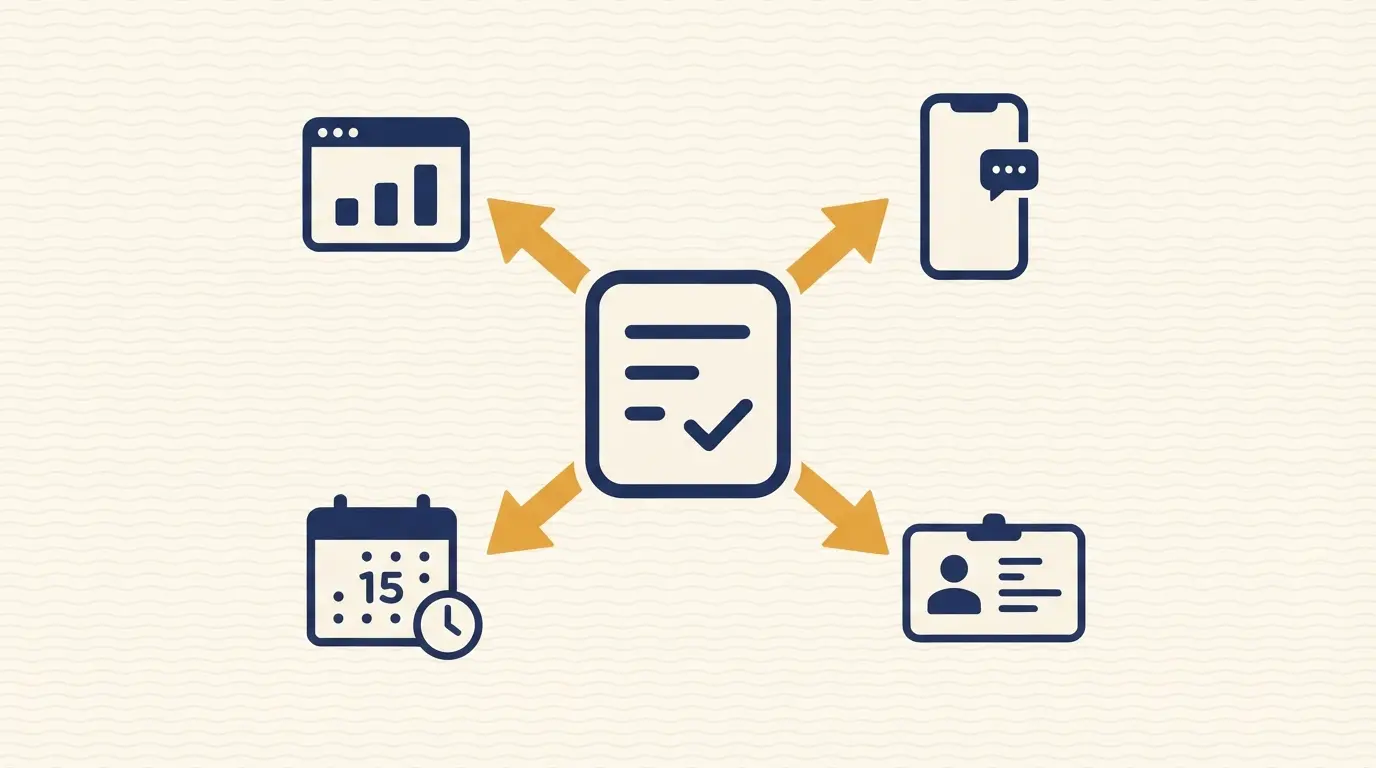
I laid out the four-step lead workflow that fires on every form: a text alert, a CRM update, a calendar step, and a client portal. That post shows how it works, and this one shows why the timing matters. Building this for local businesses is the core of my Systems & Automation work. If you'd rather build it yourself, here's the order to do it in.

Lead Follow Up Automation for Contractors: What to Automate First
Lead follow up automation for contractors works best when you build it in order of impact. Start with what saves the most leads, then add the rest. Here's the order I recommend:
- 1An instant text alert to you. Every form and missed call pings your phone within seconds, with the customer's name and job type.
- 2A missed-call text-back. When you can't pick up, the caller gets a text right away, so they know a real business saw the call.
- 3A useful first reply to the customer. Confirm the request, ask one question about the job, and say when you'll call.
- 4CRM logging. A CRM (customer relationship manager) is one shared list of every lead and customer. Every lead lands there, so nothing lives only in an inbox or voicemail.
- 5A booking link. Ready customers can pick an estimate time without waiting for a callback.
Steps 1 through 3 cover the first five minutes. Steps 4 and 5 make sure nothing slips after that.
Text First, Then Call
Your first reply should be a text, and your call should come second. Newer iPhones can screen unknown callers, asking who is calling before the phone even rings. A callback from a number the customer doesn't know can get screened out or ignored. A text with your business name tells them who you are, so they pick up when you call.
Put Your Follow-Up Into the First Day
The MIT study found that after 20 hours, each extra call actually lowered the odds of reaching the lead. So pack your effort into the first day instead of spreading it over a week. A simple first-day plan for a contractor:
- 1Minute 0: the automatic text reply goes out, and you get the alert.
- 2Your next break: call. If they don't answer, send a short text saying you just called.
- 3That evening: one more text with your booking link.
- 4Next morning: one last call.
After that, one friendly check-in text a few days later is enough. Whatever you set up, test it before you trust it.
What I See When I Test a Contractor's Lead Flow
Every lead flow I review gets the same test I described above: a real form fill and an after-hours call, timed on an actual phone. The most common problem I find is a form that works but reaches no one fast. The thank-you page loads, and the email lands in a folder nobody opens until evening. From the website's side, nothing looks broken.
The second problem is business texts that never arrive. Since February 2025, major U.S. carriers block business texts from numbers that skip A2P 10DLC registration. A2P 10DLC is the carrier sign-up that approves a business to send automated texts from a normal 10-digit number. An unregistered setup can pass every test on the dashboard and still deliver nothing.
So I send a real test lead through every system I build and check the actual phone, not the software. I also check what you see when the alert lands. If it only says "new lead," you'll call and ask questions the customer already answered. So I set alerts to show the name, the job type, and the customer's own words.

FAQ
What is a good lead response time for a contractor?
Aim for a first reply within five minutes for every form and missed call. The MIT study compared 5 minutes with 30, so five minutes is the line to beat. Your own callback can follow within the hour on a busy day.
Is 5 minutes realistic if I work alone?
Five minutes is realistic for the first reply, because automation sends it for you. Your personal callback can come after you finish the job in front of you. The goal is that no lead waits in silence.
Do I need a CRM to improve speed to lead?
You don't need a CRM for the first reply, since a text alert and a text-back can run without one. A CRM helps with what comes after: who you called back, who booked, and who went quiet. It's worth adding once your lead volume outgrows a notebook.
Get Your Free 5-Minute Audit
A personal video audit from Miguel, delivered within 24 hours, no sales call required.
Comments
Join the conversation. All comments are moderated prior to publication.
Leave a Reply
Your email address will not be published. Required fields are marked *
Related Playbooks
More articles matching this topic and category.
How a Lead Goes From Form Submission to a Text on Your Phone

Local SEO for Electricians